
Eclipse phenomena
From beginning to end, the eclipse lasts nearly three hours ,including the partial stages, if you are within the narrow path of totality.
Safely viewing the partial phase of the solar eclipse with eclipse glasses in Gabon, Africa, November 2013. @2013 Michael Zeiler.
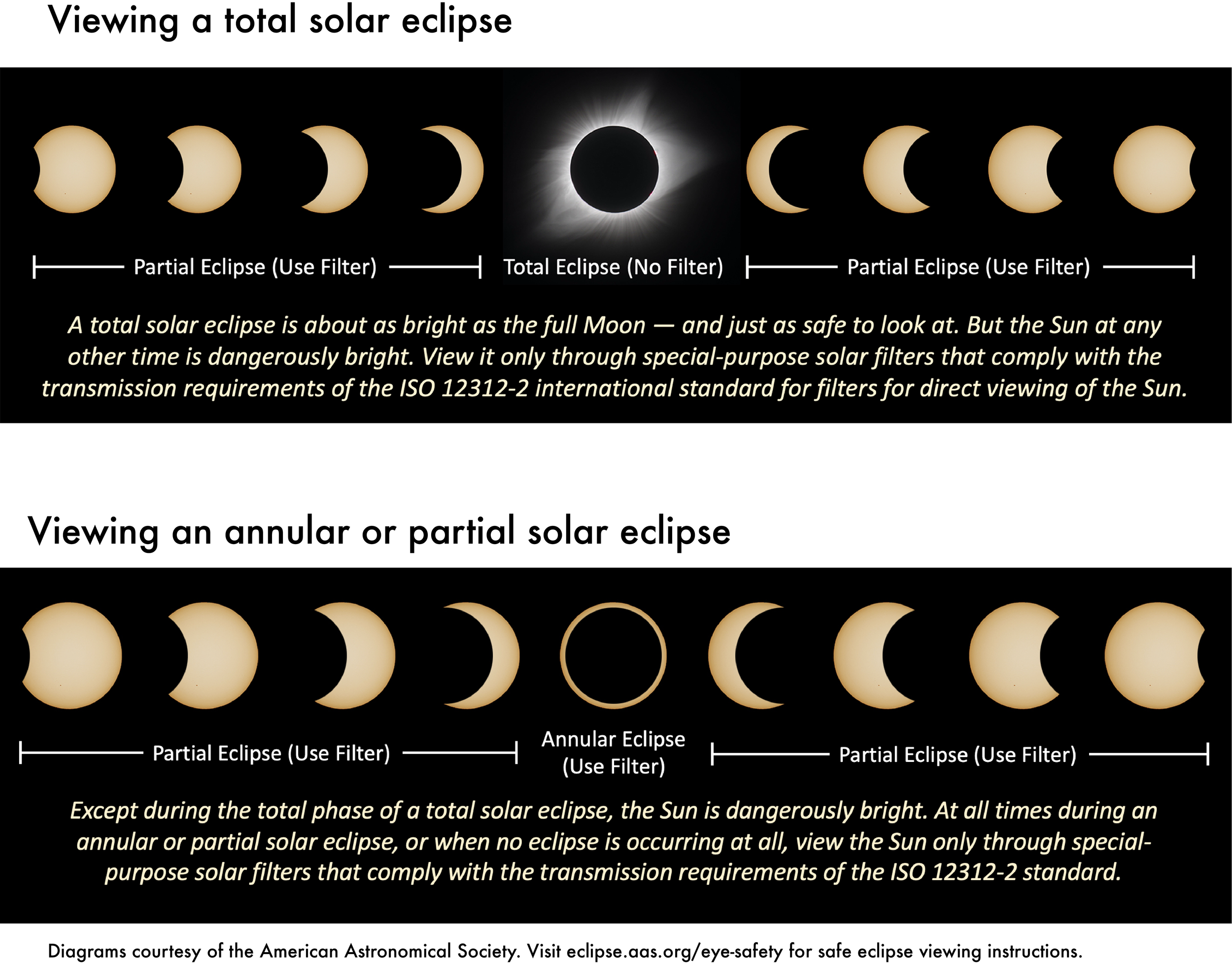
There are two general rules for safely viewing solar eclipses:
When any part of the Sun is visible, do not look at the Sun without approved solar filters that are used properly. Do not assume that sunglasses, exposed film, CDs, or any other ad hoc filter is safe. You can find certified safe eclipse glasses here. Failure to heed this rule may result in permanent eye damage. For more information on safely viewing a solar eclipses, visit the American Astronomical Society’s page.
During the few minutes of the total solar eclipse, it is indeed safe to look directly at the Sun's corona with your eyes and through binoculars. But when totality ends and it suddenly brightens, instantly turn your eyes away and put your eclipse glasses or filters back on immediately.
What will we be seeing? What is the timeline?
First contact. This is the moment when the Moon first nicks the perfect circular disk of the Sun. Do not look directly at the Sun, but if you are wearing approved eclipse glasses, you will notice a “bite” taken out of the Sun. For the next hour, the Moon will cover more and more of the Sun, until the Sun becomes a narrow crescent. During this first hour, daylight will still appear bright and if you had not known of the coming eclipse, you might not have noticed anything different. This will be a great time to look at shadows cast on the ground from leaves of trees. You'll see an amazing collection of crescents that is the tell - an eclipse is in progress.
10-15 minutes before totality. Although the eclipse will have been in progress for about an hour so far, there will have yet been no obvious signs of what is about to come. This will change quickly. You will start to notice an eerie quality of daylight. It will diminish minute by minute and shadows will grow sharper. You will also start to notice the temperature drop. If it is a hot day, this will come as welcome relief. Start to watch animal life. Birds and other animals are frequently reported to noticeably react to the impending eclipse. What do you see? What do you hear? Are they acting like it’s evening? Are they confused?
This video shows the elusive eclipse phenomena known as shadow bands in Australia, November 2012.@2013 Michael Zeiler.
1-2 minutes before totality. Your senses will seem to become hyper-alert; something big is about to happen. Sunlight will look strangely different; not day and not night. It will seem like a dim and diffuse kind of twilight. The sky will display a gradient of colors, dark to the west and blue to the east.
If you have a clear horizon, look to the west. You might see mountains or clouds in the distance turn dark. The Moon's shadow has met them and is coming quickly towards you.
Look at the ground, especially any nearby white surfaces. You may see the elusive shadow bands which are sometimes seen just before and just after totality. Shadow bands flicker and dance and somewhat resemble the ripples of sunlight on the bottom of a swimming pool.
Eclipser 1 -- stratospheric flight in Total Solar Eclipse http://www.stiintasitehnica.com/exclusiv-s-t-eclipsa-totala-de-soare-filmata-din-stratosfera-video_1695.html A Romanian-Australian scientific team successfully launched a stratospheric high-altitude unmanned balloon during the 14th November 2012 Total Solar Eclipse (TSE). Unique images and videos from the most spectacular astronomic event of the year were taken from the near out of space, along with very useful atmospheric data from the eclipse cone.
In the very last seconds before the Sun is extinguished by the Moon, you may see the very thin crescent of the Sun (through your eclipse glasses) suddenly break into a thin string of beads. These are Baily's Beads and occur because the last rays of sunlight are peeking through valleys and low points on the Moon's surface. They appear as beautiful and ephemeral sparkling points of light. The final Baily's Bead lasts for only an instant and the breath-taking sight of this last tiny bit of sunlight along with your first view of the corona is called the diamond ring.
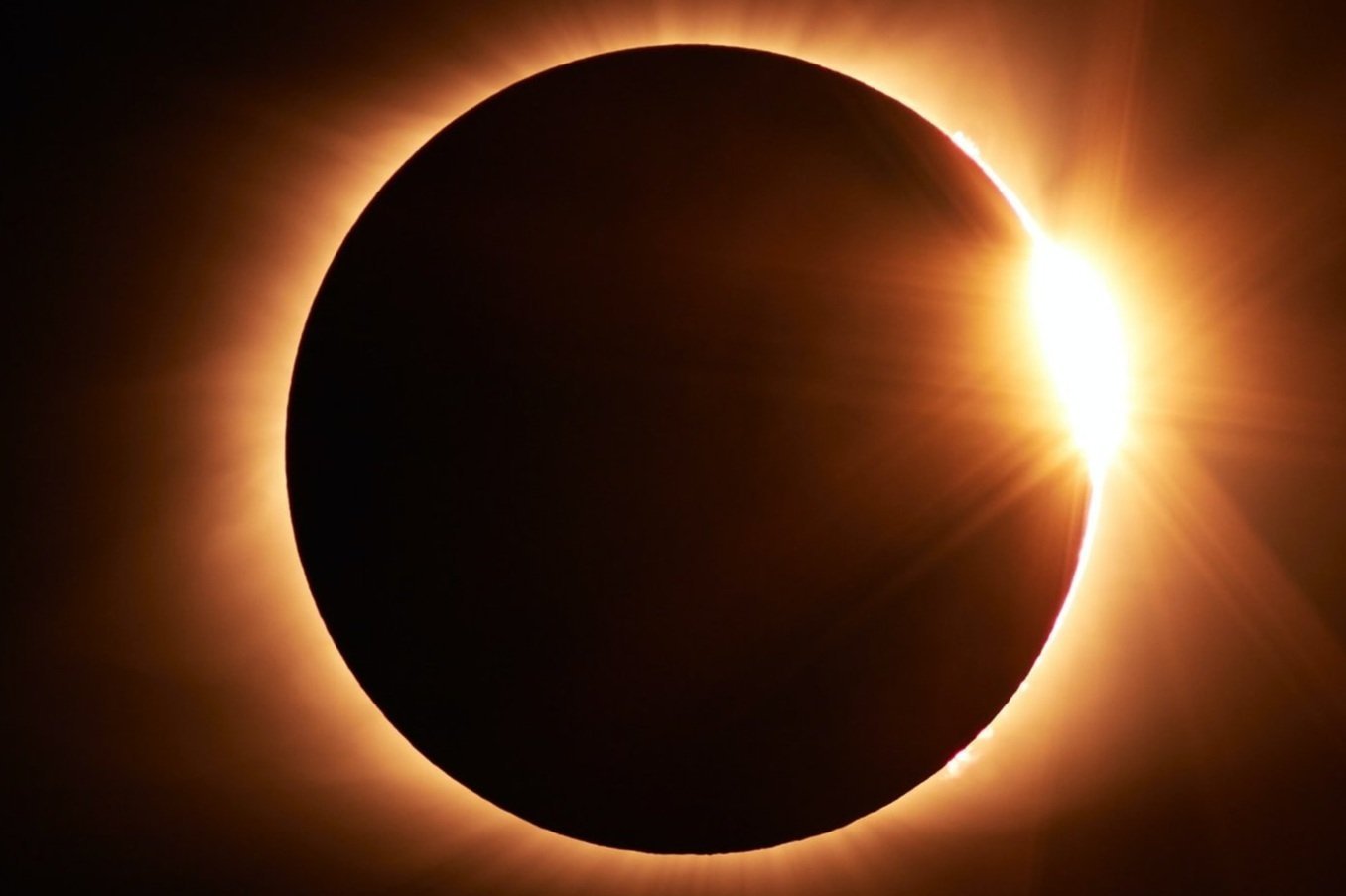
Diamond Ring

Totality! Image Credit: Dennis di Cicco / Sky & Telescope
Second contact, totality! When the moment arrives, it is unmistakable. For perhaps the first time in your life, you will be standing under the shadow of the Moon. It will be suddenly dark and there will be an audible reaction from you and others around you. If you have been wearing eclipse glasses, now you can take them off! During the total phase of the eclipse, it is safe to directly look at the corona with your eyes and binoculars.
Throughout the few minutes or so of totality, you will see something like a 360-degree sunset, brighter towards the north and south which are outside the path of totality. You'll notice darkening first to the west and as the eclipse progresses, the darkening moves to the east as the Moon's shadow rushes over you.
Photography. Our advice is to not attempt to take photographs if this is your first total solar eclipse; you will be gobsmacked by the sight. Just soak in the magnificence of the spectacle and look at the corona and the sky. If you want to do photography, it's best to either start a video camera or still camera in time-lapse mode on a tripod before totality so that you may watch totality without fiddling with your equipment. If you have a video camera or still camera in time-lapse mode on a tripod, set your lens on a wide-angle setting and try to include your family and friends in the view. There are solar filters for your cell phones here, so you can take quick images with your phones, but we encourage you to just watch.
Chromosphere and prominences. If you view totality through binoculars, you will notice an innermost and irregular layer of deep red. This is the Sun's chromosphere. This is a shallow layer so it is mainly visible against the edge of the Moon. You may also see what appear to be several small “flames”. These are solar prominences and their number and degree are variable from eclipse to eclipse, depending on the level of solar activity.
Stars and planets. The brighter stars and planets will be visible during totality. Read our Field Guide to the 2023 and 2024 Solar Eclipses for detailed info on this. Mercury, Venus and possibly Jupiter will be visible during the April 8, 2024 total solar eclipse.
Third contact; end of totality. After a few minutes, depending on your location, the total solar eclipse will end all too soon. The end of totality will be marked by a second diamond ring and Baily's Beads. Be sure to watch this only with your eclipse glasses back on. You can find eclipse glasses here.
From this point, all the phenomena leading up to totality will play again in reverse order. Watch again for shadow bands in the first minute after totality if you didn't see them before. Look at the shadows from trees and see if you can see the striking crescent projections during the ending partial phase.
When the eclipse is over, we hope that you and others will share your momentous experience with each other and your larger communities. We also hope that the young people among you will be inspired by this event to take up the study of the sciences and/or astronomy, and come to understand our magnificent universe, sharing that with others.