
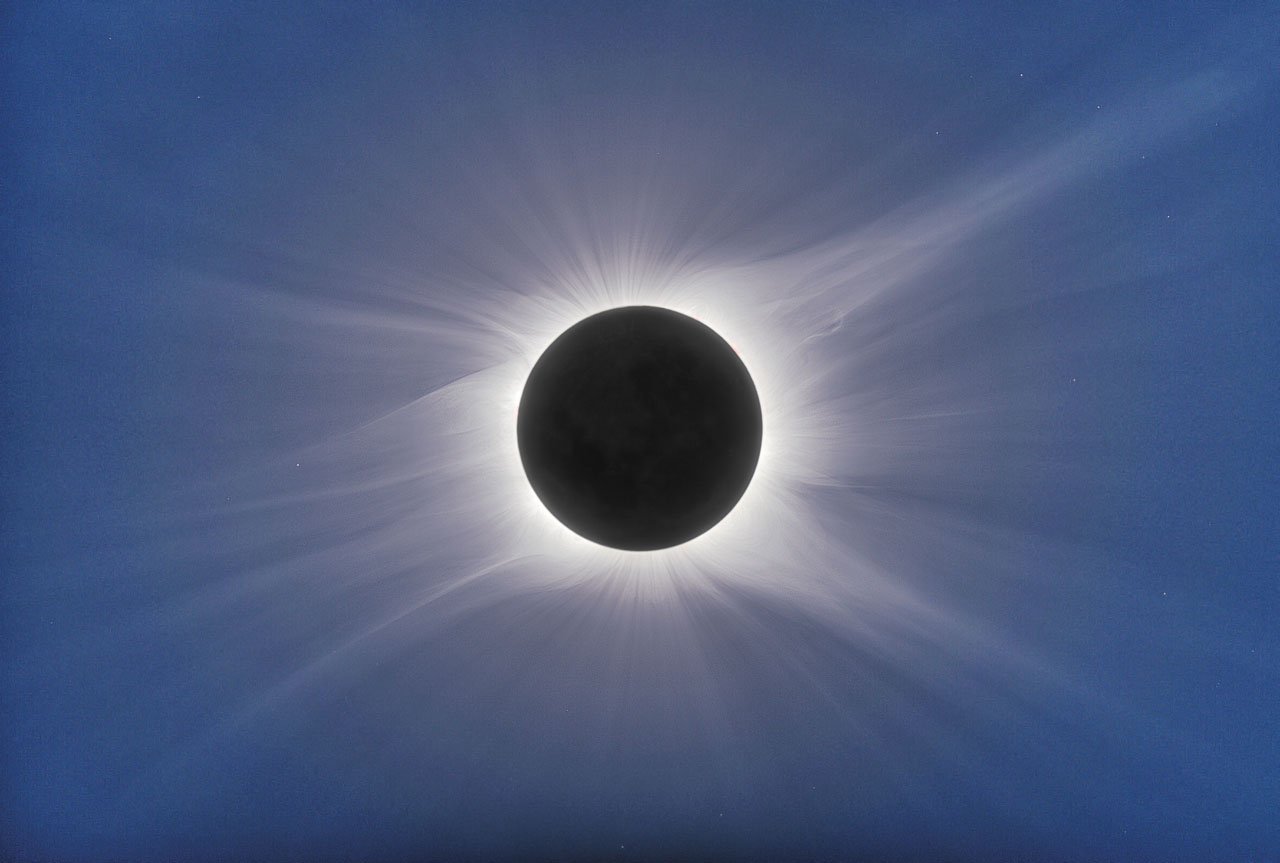
Totality as seen from Easter Island on July 11, 2010. This is a composite of short, medium, and long exposures, as no single exposure can capture the huge range of brightness exhibited by the solar corona. No filter was used during the exposures, as totality is about as bright as the full Moon and just as safe to look at. At all other times, though, a safe solar filter is required to observe or photograph the Sun. Credit: Dennis di Cicco / Sky & Telescope
Eclipse Basics
What causes a solar eclipse? The first fact to understand about solar eclipses is that they occur because of a remarkable cosmic coincidence: the Sun is about the same apparent size in our sky as the Moon. While the Sun is actually about 400 times larger in diameter than the Moon, the Moon is also about 400 times closer than the Sun. Therefore, the Sun and the Moon appear to be about the same size in our sky.

Image credit Bill Frymire
This single fact explains why we see total solar eclipses - the Moon has an apparent size that just barely covers the Sun completely, yet is not too large that the Sun's atmosphere, its corona, is eclipsed as well. We on Earth occupy a celestial sweet spot to witness this sight. We are the beneficiaries of a wonderful cosmic coincidence, lined up like a cosmic billiard shot.
It was not always so. When the Moon first formed around our Earth over 4 billion years ago, it was much closer to the Earth and appeared much larger in our sky. So total solar eclipses in the early epochs of our Earth did block the Sun but also most of the corona. Over the eons, the Moon has been gradually receding from the Earth due to the friction from the tides. At present, the distance from the Earth to the Moon increases by about an inch per year. In some distant future epoch, the Moon's disk will become smaller such that no more total solar eclipses will be visible from Earth.
When is the next eclipse?
The next eclipse in the United States will be the annular eclipse on October 14, 2023. Then, just less than six months later, there will be a total solar eclipse on April 8, 2024. Both will be truly amazing experiences! We encourage all of our readers to make every effort to see them. If you do not live in or near the paths of annularity and/or totality or cannot travel to see these eclipses, please sign up for our e-newsletter in the upper right corner of this page. We will email various links where you can livestream these events.
Depiction of the umbra and penumbra at a moment of time during the 2017 total solar eclipse.
What are the umbra and penumbra? When you read about eclipses, the terms umbra and penumbra are frequently mentioned. These are the two types of shadow cast by the Moon. The umbra is the inner shadow. If you stand inside the path of the umbra, the Sun will be completely blocked in eclipse. The penumbra is the outer shadow. If you are outside the path of the umbra but inside the broader eclipse area, the penumbra, you will see a partial solar eclipse.
What are the types of solar eclipses?
We just described how total solar eclipses happen. While the Moon and Sun have nearly the same apparent size in the sky, their apparent sizes do vary slightly because of two factors; the Moon is in a slightly elliptical orbit around the Earth and the Earth also revolves in a slightly elliptical orbit around the Sun. These variations result in the circumstance that sometimes the Moon's disk does not completely cover the Sun's disk during eclipse. These are annular solar eclipses and a prominent example of this eclipse type occurred in the United States on May 20, 2012. The next annular solar eclipse in the United States will be on October 14, 2023.
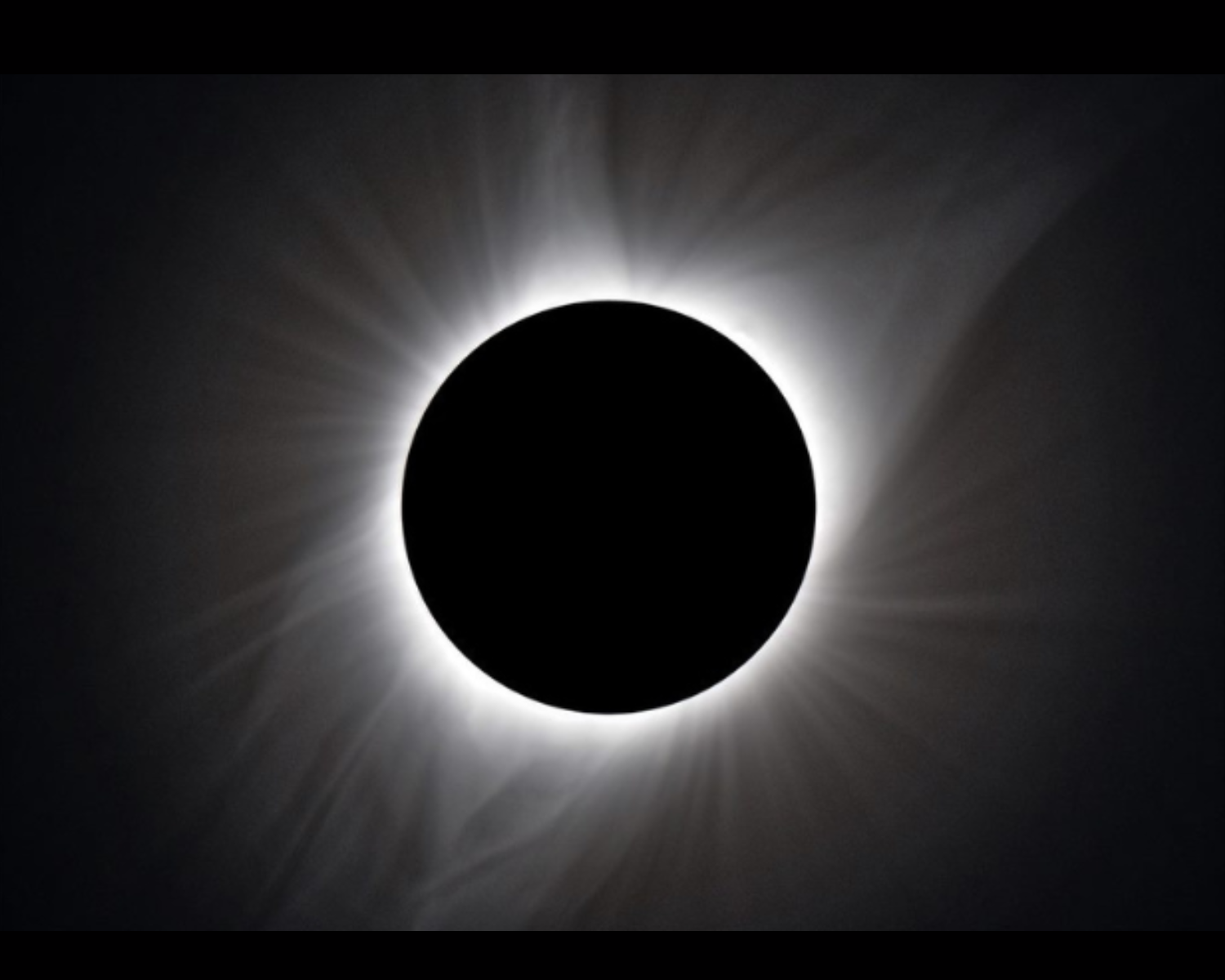
total solar eclipse August 21, 2017 by michael zeiler
Annular solar eclipse on May 20, 2012. © 2010 Alson Wong, www.alsonwongastro.com/
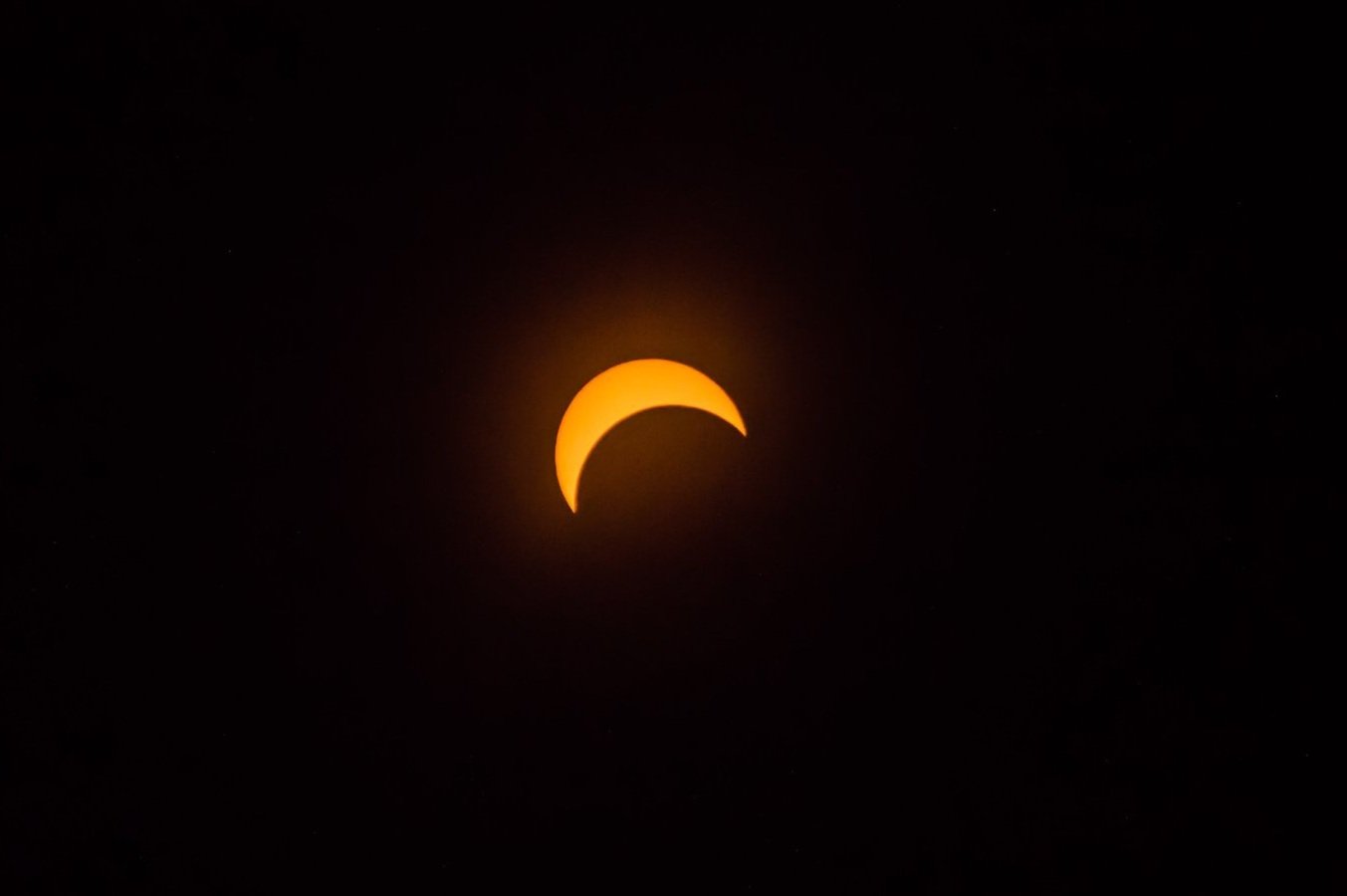
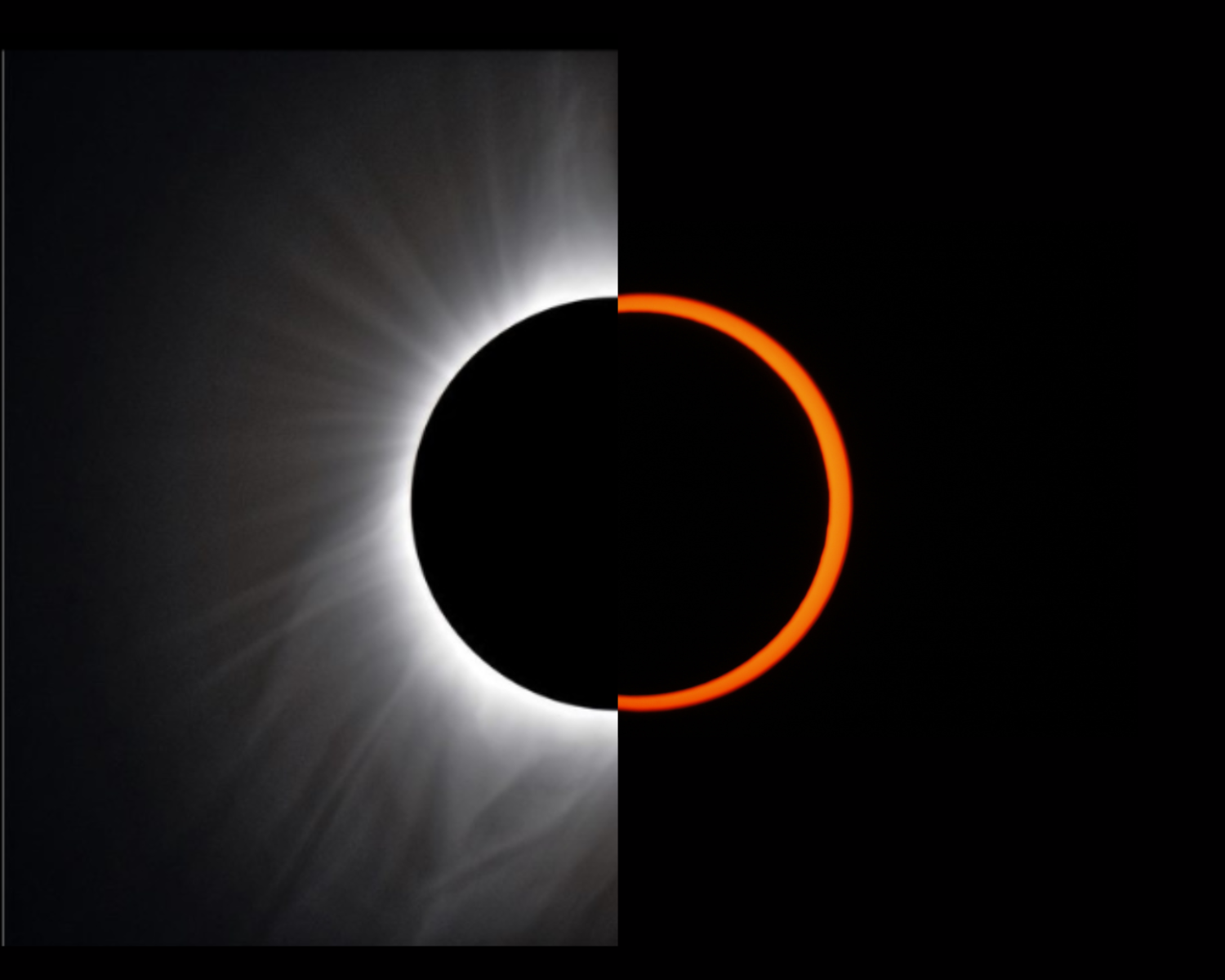
Image credit Michael Zeiler / Alson wong
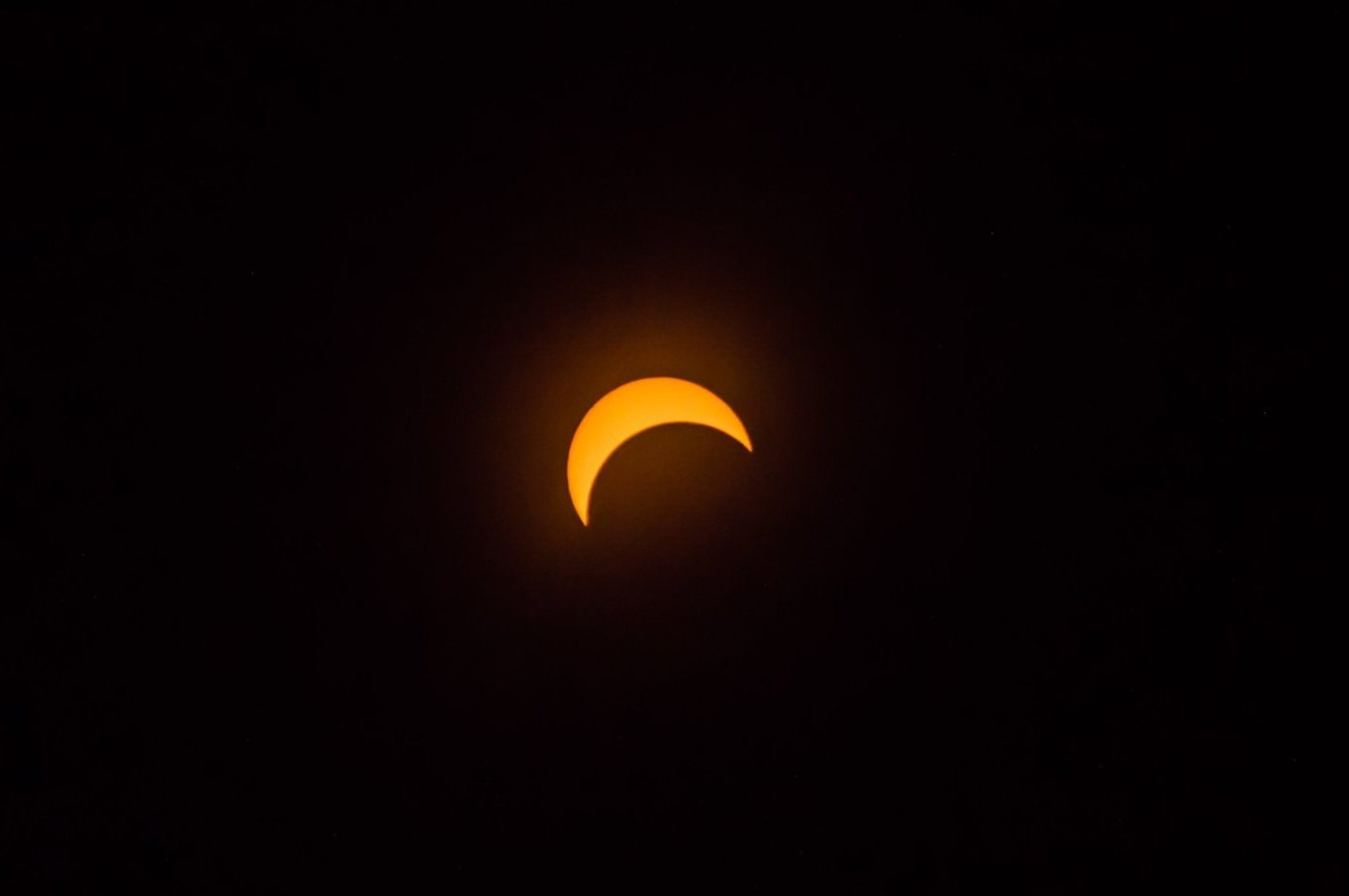
While an annular eclipse is a striking sight, it does not command the same overwhelming sense of wonder that a total solar eclipse does. Daytime is dimmer but not twilight. Because some of the Sun's disk is still visible, it is much too bright for the Sun's corona to become visible. It is never safe to look directly at an annular solar eclipse, even at its maximum phase. Always use certified safe solar eclipse glasses, like the ones you can find here.
If the Moon's shadow is not centered on the Earth, then another common type of solar eclipse occurs; the partial solar eclipse. During a partial solar eclipse, the umbra misses the Earth, and from everywhere the eclipse is visible, you will only see part of the Sun eclipsed. Again, at no time during a partial solar eclipse should you look directly at the Sun without certified safe eclipse glasses, solar filtered viewer like our SUNoculars, or a pinhole projection.
Hybrid solar eclipses are quite rare, but they do happen. They are also sometimes called central solar eclipses or annular-total solar eclipses. The Moon may not quite cover the Sun at either end of the path (annular) but will cover it at the middle of the path (total). An example of this type of eclipse will occur on April 20, 2023.
Why should we go see an eclipse?
“Solar eclipses are the most beautiful sight you can see in nature!” says Great American Eclipse cartographer, Michael Zeiler.
“There are precious few events in life that leave such an indelible impression that the simple act of recollection can quicken the pulse and increase respiration as vivid memories flood one’s mind. The total eclipse of the Sun is just such an event” says Fred Espenak, aka “Mr. Eclipse”.
“It will absolutely blow your mind to stand in the shadow of the moon and see the solar corona with your own eyes!” says Great American Eclipse co-owner, Polly White.
“Indeed a total solar eclipse is awesome in the truest sense of the word,” says Michael E. Bakich, former senior editor of Astronomy Magazine and Great American Eclipse co-author of the Field Guide and Atlas.
“It is the coolest way to see our solar system in action.” says Great American Eclipse senior staff member Nyssa L.
“Clear Skies!” - The importance of weather
Eclipse chasers around the world wish one another “Clear Skies!” because it is the most important thing to think about when starting your eclipse adventure planning. Cloudy skies can and will block your view. It is important to select your viewing site carefully. Eclipsophile.com is the best online source for checking the climate and weather for celestial events.
Why don’t solar eclipses happen every month?
If the orbit of the Moon were exactly within the same plane as the orbit of the Earth around the Sun, then total (or annular) solar eclipses would occur every lunar month. However, the orbit of the Moon has a tilt of about 5 degrees with respect to the Earth's orbit around the Sun.